Showing posts with label Women. Show all posts

Friday, 19 August 2016

Power!


I let out an involuntary groan as the name ‘Ben Steed’ appeared on my screen. After last week’s episode, which rewrote Dayna as Jo Grant, disposed of the only other season regular as if she was a bunch of carnations that had gone past their prime, and featured the new regular, Soolin, as something of a Bond girl, ostensibly deadly but (within those 45 minutes) mostly decorative, we have an adventure from the author of The One Where Servalan Gets Humiliated By A Bloke In A Tracksuit and The One Where A Glove Puppet Disguised As A Computer Orders Men to Molest Woman As Punishment.

I am, perhaps, a little unfair. The interesting thing about Steed is that he is determined to make misogynistic violence a theme. Servalan’s awful boyfriend is, ultimately, just Steed trying to write Travis – he’s a villain and he doesn’t survive the story. Moloch and the Federation baddies are greedy, ineffectual fascists – the one eyed hand puppet symbolises them neatly. In this story, the woman-hating Hommicks are stupid primitives, fighting a bunch of beautiful women so clever they’re telekinetic.

The subtext of these stories is a giveaway, though. Jarvik, in 'Harvest of Kairos', turns out to be a brilliant strategist and fighter precisely because he’s such an unreconstructed MAN. Servalan is led into trusting him because, deep down, she’s all WOMAN. In 'Moloch', the women of the Liberator have little or nothing to do with the plot proper. The only female characters in the story are victims of the Federation’s brutality: that’s the only reason they’re there, and it’s hard to see where they fit into the rest of the history of the planet. And in this story, well, where to begin? The downtrodden wife who self-righteously, heroically, calls herself a woman, rather than a Seska? Avon’s battle of wills with Pella, and the big life lesson that “men will always be stronger”…? Followed by a snog?!


To be honest, though, it saps the will even to write about this story because it’s so incredibly threadbare. They only have 45 minutes an episode, but have to contrive a convoluted plotline involving the riddle of a locked door to which Avon knew the resolution to all along, turning up in the nick of time to sort it out. Steed is so determined to tell his doomy tale about the battle of the sexes that the entire planet is represented by six people by the end (I don’t just mean represented onscreen – the Seska population is just five women, and they’re all dead by the end of the story). Steed can’t think of anything to do with Soolin for the story so just has her hide under a table somewhere.

In addition to which, we seem to have arrived back again with the tribes of the future middle ages that seem so ubiquitous in the universe of Blakes 7. Where are the ludicrous excesses of yesterseason, the lurex and leather and wild eye make-up? Has this show grown so embarrassed about its visual appearance that it’s decided to just play things down – because if so, it’s going to be a very long season. In Doctor Who we’ve just had the Argolins, the Vampires, the Tharils, Trakenites and Logopolians. Blake's 7 could at least have nicked some of their costumes.

Come on, guys, it’s your last season. Stop worrying about what everybody else thinks. Live a little!
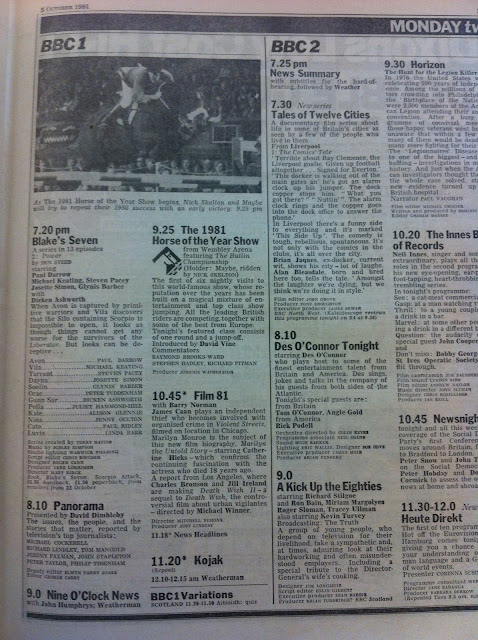
Friday, 22 July 2016

Moloch!


Well, where to begin…?

I have a new game I play when I watch Blake’s 7. It’s not a drinking game, although I’m pretty sure the drunker you are, the better the show is. No, it’s very simple: just as the title card comes up (bwwwaaaaa…) I close my eyes (bwwwaaa…) and then I have to see how quickly I can guess who has written the episode.

Now, I was vaguely aware that Ben Steed had written more than one episode because of something muttered in the opening episode of fan podcast Down and Safe (if you get the chance, I urge you to download it and listen yourself). And I knew it couldn’t be Trevor Hoyle, because he’s just had a turn. I didn’t for a second think it was Terry Nation, but I might have guessed him before I guessed Chris Boucher or Robert Holmes. Their work, as I said in relation to 'Rumours of Death', is happening in two different eras of television. Terry Nation’s still essentially writing for the 60s. Chris Boucher’s story structures can be seen on BBC 1 today.

Ben Steed, on the other hand, writes for the era that time and taste and all right thinking people forgot. I pegged this one as his, as soon as the mysterious overseer (later revealed as Moloch, later revealed as a malignant computer, later revealed as a small felt glove puppet with one eye) told the Federation troopers what to do with the woman who has betrayed their whereabouts to the Liberator.

“Give her to your men.”

Now, it’s all very well for me to big up Chris Boucher as the better writer – but it should also be highlighted that he was the script editor for this season. I like to believe that Boucher saw strong female characters as an important element of the show – as character outlines, Dayna, Cally and Servalan are all stronger figures than virtually any other character but Avon. ‘Rumours of Death’ pivots on a strong, complex, dangerous female character – and even when Servalan is tied to a wall, she has maximum power.

So how could he let through a script where women are implicitly raped offscreen; where, in fact, there are only two female characters in the story so that this particular form of violence can be employed? Steed is, perhaps, trying to demonstrate the depravity of the planet’s rulers, an echo of the child abuse storyline in the series’ pilot episode: except that the tone of those stories was 1984, and this one feels more like a surreal episode of Allo Allo. Vila happens to befriend a misogynistic murderer, and when he’s told he’s going to be given a woman for serving the Federation, he trots along looking really quite cheerful about it.

Stinky old Carol on Vila-world wouldn’t be very pleased to hear about this.


I mean, you don’t need to hear it all again, I don’t need to say it all again, but Servalan gets humiliated by one of her officers, again. Cally spends the whole episode working the teleport, and manages to get that wrong, twice. Dayna does nothing in the episode but ask Avon questions (not very different from last episode). I’m expecting at least one of the female regulars to leave next season. And I bet there’ll be another bloody awful Ben Steed story then too.

The story is a mess, with a magic computer on an invisible planet and too many people making overly complicated plans with it. The design is lazy, the effects work is dreadful (is that really supposed to look like a human being floating in that tank?) and in the conclusion, the plot just self destructs: Moloch, the hyper advanced alien, can’t survive without his life support machine and Avon runs away from Servalan (who has a teleport bracelet, and didn’t manage to kill Vila or Tarrant when she was face to shoulder-pad with them).


What’s really sad is that I see we are nearing the end of this season. This time last season, everything was gearing up toward the destruction of Star One – this time around, there’s absolutely no continuity at all and no sense of direction. Where is Servalan going? Where is Avon going?

Come on, Chris. Prove me wrong. Two more stories to go. Surely this Ben Steed story was penance enough. Let’s get back to the good stuff.

Friday, 1 July 2016

Rumours of Death!

This story made me feel for Terry Nation. After two and a half seasons, the best episode of your show airs, one that fulfils all the promise of the characters, setting and format, and you didn’t write it! I can imagine him feeling something similar when ‘Evil of the Daleks’ went out. From the very opening of the episode, where Avon at his weakest suddenly reveals himself to be Avon at his strongest, and questions are answered while asking a hundred new ones, this feels not only accomplished but modern. Plenty of Nation’s B7 scripts play with their audience at the eleventh hour, but to do it in the opening minutes – to fill the entire episode with that tense, unpredictable energy – is all too clearly the hallmark of a different generation of TV scriptwriting.

Then there are the flashbacks: cleverly interspersed so that we are wrongfooted from the start about Anna. Like Avon’s struggle with her identity, but we piece things together from the other end – and with the absolute certainty that things are going to turn out badly for him, for her, for everybody. We see Anna from Avon’s perspective, the edges rippling with the eddies of memory and fantasy, and possibly with some of the futuristic fizzy wine they’re enjoying.

We see his image of her in a cell, waiting for the return of the Federation agent who will torture her for information – an agent who, we later learn, was never coming for her, if she was ever in that cell at all.

The whole story is about pictures that mislead. Here’s an 18th century country house: it’s actually the newest thing on this future Earth, a cheap location but  an insane act of lavish grandeur from everyone’s favourite ‘tasteless megalomaniac’. Having blasted her way out of the image of speechifying (male) dignitaries that appears in so many Blakes 7 openers, Anna and her men (disguised as Federation troops) disrupt the surveillance cameras, and then present a misleading image back to the security team, who are busily telling Servalan that everything’s fine, it’s absolutely fine…

What about the crew of the Liberator? It’s the worst cliché to say that actors are always asking about their motivation, but here’s a story where we know what everybody’s after, what their agenda is, their vendetta or their friend’s vendetta or the vendetta of the man they hope to replace as captain (of sorts) of the ship, and the performances are accordingly sharper and more satisfying. I’m thinking particularly of Jan Chappell, who has suffered in the past from being half-protagonist, half-plot device. In this story, you can believe that these are veterans of a conflict and not sure which way is up any more.

This is a good episode all round for female characters, actually. They still don’t outnumber the men, but they have some of the most powerful roles, without being reduced to beautiful superheroes who are punching above their weight, or space vampires. There’s one shot in particular, where Anna leaves the debating chamber, having argued for the life of Servalan, heads off up the corridor for some unknown purpose, and Cally and Dayna steal after her. Blakes 7 is not a horribly sexist show, but it does tend that way sometimes, and when it’s going the other way it sometimes feels a bit pleased with itself. In this story, it’s unremarkable that all the women are strong, dangerous and well differentiated.

Servalan, meanwhile, is chained to a wall in the cellar, in her evening gown, naturally. Once again, I can only imagine Harvest of Kairos was made accidentally. How could the production team treat so casually what they give such potency here: the humiliation of Servalan, her tenacity, her strange relationship with Avon and Tarrant. Boucher handles this so minimally, keeping her dialogue brief and bitterly significant.

At the end of this episode, Avon kills the woman he loves and liberates his enemy. What exactly does this struggle represent? What are they all fighting for? Is it possible to avoid your fate, when you spend your life chasing after it with plasma bolts and crazy schemes? It’s a perfectly composed, shot, performed little Greek tragedy in space. I think Terry Nation must have felt somewhat jealous – but perhaps proud, overall, of what the show could be.