Showing posts with label Character Stuff But Not Really. Show all posts

Monday, 31 October 2016

Warlord!


So, after all this palaver, am I a Blake’s 7 fan? Would I wear that title, own up to it as gladly as I do ‘Doctor Who fan’, 'Victoria Wood fan' and ‘Kate Bush fan’ (worlds which seemingly overlap that of Blake’s 7 like a Venn diagram)? I’ve certainly been thinking and theorising about it for a good long while. I’ve seen every episode. I’ve even written fan fiction, if you count last week’s attempt. (Actually I did try to write Blake’s 7 fanfic at school, based entirely on four episodes I'd borrowed from Dulwich Library. It was written in the 1990s and involved cyberspace, and these two facts are somewhat connected. But I digress.)

I must say, it was a struggle to watch the show at some points, but a struggle with myself more than anything. How many times had I heard my beloved Who described as slow, sexist, badly produced tat? Elsewhere I've made a case for the Hartnell era as a series of relaxation tapes with Daleks in, for Troughton’s episodes as flawed but well-meaning attempts to depict women in strong roles, for Pertwee’s trashier SFX to be more pleasurable than CGI. I’m sure if someone said that Sarah-Jane Smith enjoys zero character progression from Irongron to Eldrad, I’d say: that’s not the point!, or, That’s a narrative gap for the viewer to complete!

It turns out that however true all of this is, watching new things that operate by familiar rules is still a mental jolt. Without a prior attachment, we don’t necessarily overlook pacing issues or see past poor special effects or fill in the gaps the scriptwriter conveniently left for us. Anything on first viewing has a different look to something re-viewed, as if we need to see it stereoscopically to really appreciate its depths and shallows. Perhaps this is more natural to Doctor Who, which was retelling its earliest stories from An Exciting Adventure by David Whitaker onwards. Quickly I thought I had the measure of Blake’s 7, even if I did have to squint at it slightly to see through the fluff and crackle of time. Then there were developments, surprises, leaps forward and backward.

I love Doctor Who, not only in spite of its flaws but because of them. I tend to think of this as a moral education. Life ain’t perfect, memories do lie, stories time to be told, ‘Nothing gold can stay’, all CGI will one day depreciate in value. But could I love Blake’s 7 in quite the same way?

'Warlord' was a bit of a test.

It really is a curate’s egg, this story, and once again all the usual flaws of Blake’s 7 are on display. Regular characters behave as if freshly invented for this story – anything from last week might as well not be canon for all Avon and co. care (what happens on Virn stays on Virn, perhaps) (except it didn’t!). Underwritten characters are massively hammed up by the cast, resulting in a cheese and ham sandwich. The women in the story have little or nothing to do. The story is fairly predictable from about ten minutes in, with any important characters conveniently dead thirty seconds from the end. Avon is having another go at Servalan that will come to nothing: Servalan is laying another trap for Avon that comes to nothing.

In the story’s favour, it should be said that Servalan’s plan doesn’t fail entirely. At the end of the story, the Avon’s Five have had their base destroyed. The antidote for the Federation’s new drug will never be manufactured. The allies from the unaligned worlds – all of whom have fabulous space hairdos – are presumably dead or extremely hacked off. I think even Orac might have been smashed up. All of this makes more dramatic resonance because absolutely nothing has happened to affect the gang’s world since Soolin came aboard. In retrospect, it makes sense that Servalan simply couldn’t find them, and once she could, she trod on them, eminently casually. It’s not a bad story for Servalan as one-dimensional supervillain, just as Soolin and Avon get a juicy fight scene and Vila gets drunk and morose when things are against him.

Dayna gets to press a few buttons. Well, I did say the character stuff was a major flaw.

The whole story is shot brilliantly. From the opening, eerie vision of doped-up citizens stamped with a barcode number, gunned down on the escalators, through the desert sands of the alien planet to the destruction of Scorpio base, the director is obviously doing everything he can with the show (and the whole season has made a determined stab at raising the show’s production values). Zukan’s vision of his daughter’s anguished face and the accusing look of Servalan are cheesy, but you can’t say they’re not trying.


Ultimately, though, there is an obstacle to my fandom. I just don’t care about the characters. Not only are they not consistent with any other stories, they’re just not very impressive or imaginative. In the midst of a huge diplomatic negotiation, Avon’s friends double-cross their most powerful ally by hiding his daughter from him: this doesn't seem wise from where anyone's sitting, pink topknot or no pink topknot. They also underestimate one of the most aggressive and nefarious men in the galaxy. No Harry Sullivan's or Barbara Wright's here, no Sapphire and Steel or Steed and Peel. The Scorpio crew are more like a collection of sit-com characters in search of a laughter track, and perhaps, yes, that does make us identify with them more than ever. They're as fallible, clumsy and motivated by sex as any of their audience. But equally there is no sense from them that anything much is at stake, whether the defence of their base or the attack on the Federation. The destruction of the base is done so easily efficiently that you wonder why it didn’t happen sooner.

Blake’s 7 reached its penultimate episode leaving me hugely unsatisfied. A show pivoting on its disreputable anti-heroes has quickly become one where the lead characters are under-emphasised and underwritten. 'Warlord' is brainless, heartless and vaguely good-looking, but I’m afraid both the show and I are ready now for its concluding episode.

But does that mean I'm not a fan? Perhaps it only reiterates my attachment to the show, my deep investment, my curiosity. Because I care about something innate and ineffable about the show, something  that's not really there in the script or onscreen, but between the two, read between the lines. I'm really curious about how they're going to end this thing and draw everything together. I'm even wondering what stories fans have told about what happens next...

Am I a Blake's 7 fan? The jury is still out...


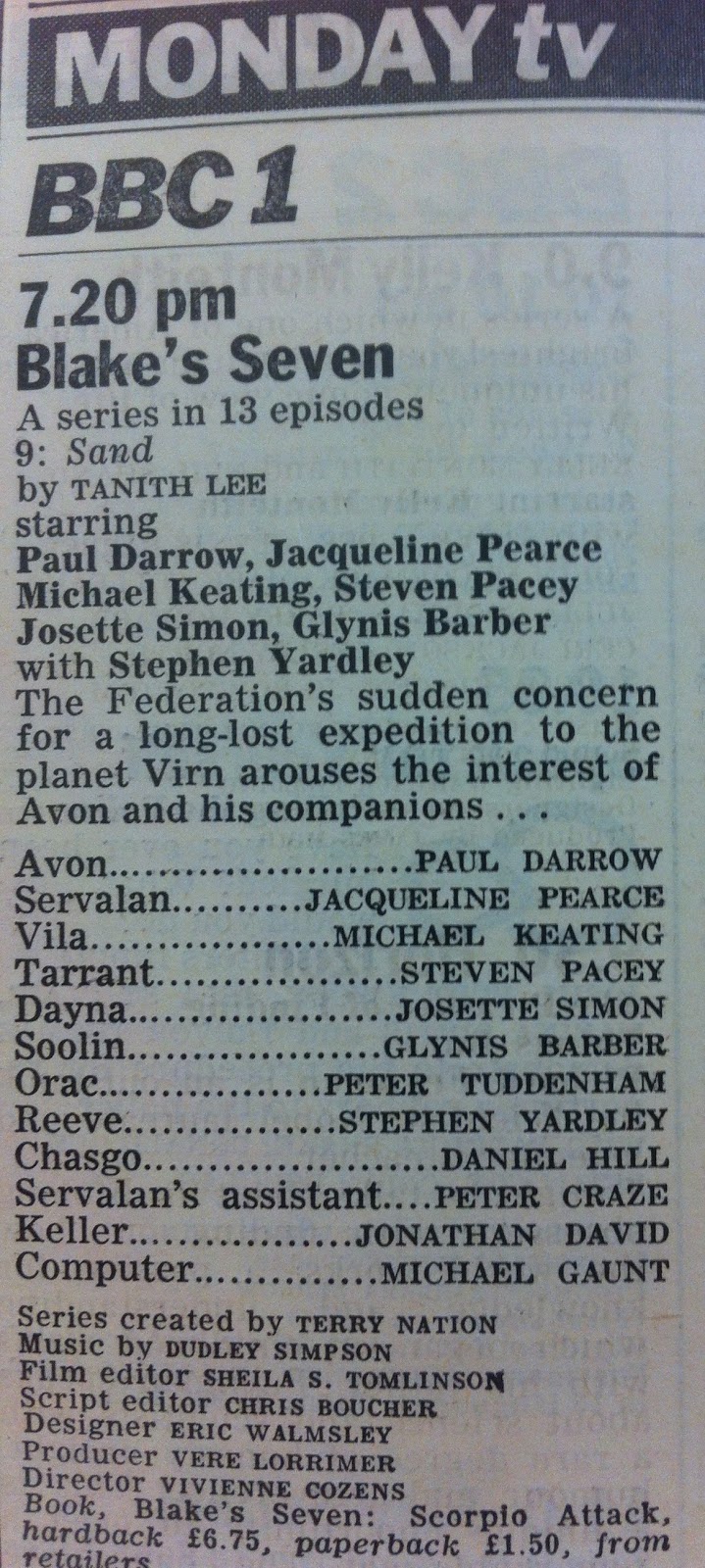
For the penultimate time, blurry snaps of the Radio Times are by me (thanks to the British Library). Screencaps are from this excellent site (thanks to Lisa).

Monday, 10 October 2016

Sand!


It’s the singles bar at the end of the universe, and now that Servalan has arrived: it’s ladies’ night…

I’m several stories ahead of the blog. By the time you read this, I’ll have left the dusts of Virn behind. (I’ll have passed beyond Blake’s 7 and a little way into whatever comes next. Edge of Darkness? Emu’s Pink Windmill?) I happened that, just after I watched ‘Sand’ and before I wrote this, I posted my blog about Tanith Lee’s first contribution to the show, ‘Sarcophagus’. (Click here to go back and read it if you like: you are now spiralling in time, try not to trip over that hat-stand). And rereading that was interesting.

It strikes me that I started the review talking about character. Character continuity has always beset this series. It looks like a character-driven show, and perhaps it is, but it’s driven like a go-kart round a track: however fast they go, they circle around to the beginning again. After a while, I got used to this: the same way new viewers get used to the fact that Tom never goes back for Sarah after ‘Deadly Assassin’: it’s a convention, a necessity, a loveable quirk.

In ‘Sarcophagus’, the episode pivots on an understanding of a romantic kind between Cally and Avon that might be there if you dig in the subtext of previous episodes. It’s a small fire generated by the friction of knowing glances, and the most knowing of these is shared between the viewer and the writer. Tanith Lee, like Chris Boucher before her, reveals herself to be viewer-as-writer: she doesn’t know the characters like Terry Nation, but she writes with the implicit authority and insight that all we viewers take for granted.

The Cally-Avon romance basically peters out after the end credits of ‘Sarcophagus’, but for the duration of the episode, along with some of piquant stylistic touches (cosmic folk, especially) Lee convinced me she was sharing a personal insight into the world of these characters.

I used to bemoan the huge number of regulars in the show: now I see them as multiple viewpoints on a world that needs exploring in multiple dimensions (City at the Edge of the World is a great example). And in a show like Blake’s 7, it’s not location work or special effects that create your world, not backdrops and backstory. It’s about how a character sees the world, how they inhabit it, and how they try and shape it. Lots of writers beam the characters down to the ‘planet of the week’ and have them act as disinterested participants, like gamers or tourists. It ought to be more like Chaucer: there’s a reason this story happens to this person.

This charming, brittle, beardless youth of a Federation Captain, who spends a night with the most dangerous woman in the galaxy on a planet of ghosts. This grumpy, battle-weary genius, half-seduced and half-sickened by the President’s power, hanging powerless in her orbit. This planet that engineers a story, divides and destroys and draws together its victims, and heaps up along the windows like a gestalt voyeur, as they gulp their green-ade and blue-ade and get up to who knows what. Obviously, this turns out to be a story about Servalan, and doesn’t Jacqueline Pearce shine, but Tanith Lee’s approach to Serv isn’t through a new world but a man who knows her, in every sense. Two of them, in fact, although one of them is dead as the story begins.

Green dust, black evening gown, dead man in the next room: that’s Blake’s 7.

This is the reason we have Season Four, then, to give Servalan a story in which the mask slips, if only a little. ‘Power became my lover,’ she says. And so Don Keller, the man who dumped Servalan, the warm corpse next door, becomes the reason for the events of the last three seasons. Yes, for the duration of this story, the power games of Blake, Tarrant and the rest all boil down to a lost love and a confrontation with the past in a world – a situation – where such things are briefly in focus. What else does drama do but invent the one world where one unique story can be told?

Next week, it’ll be another world, and maybe another viewpoint will open up. Somehow I doubt it - stories like ‘Sand’ don’t come along very often - but we watch on optimistically. I expect Servalan will be back, and the crew won’t mention Tarrant’s betrayal: he’ll seem to forget, and so will she. As usual, the viewer will fill in what they can remember and what they suspect, and tell their own story. One shaped forever by the particular insights of this richly beautiful, bizarre and chilly alien world…


Friday, 26 August 2016

Traitor!


            “Blake would have been proud of you,” sneers Vila.
            “He probably would,” replies Avon coldly. “But then, he always was an idiot.”
            The story of Kerr Avon in Blake’s 7 is rather surprising. For a while you’re certain he’s going to mutiny. His main reason for getting up in the morning appears to be critiquing Blake. In fact it sometimes feels like it’s only because he’s curious how far Blake’ll go that he’s holding back: he’s like the companion figure in Doctor Who, a viewer surrogate. He even talks like a disdainful Gogglebox viewer who’s somehow got through the screen into the story.
            And one of the people he’s watching is earnest, hot (and curly) headed self-appointed leader, Roj Blake. We rarely see Avon’s moments of heroism when he’s isolated from the crew, but there are a couple of crucial episodes in the first two seasons where Avon heads off to rescue his hapless leader at risk to his own life when he could as easily take off in their psychic spaceship.
            Throughout the Star One narrative, Avon criticises Blake’s judgement pretty often (this is because the script editor’s role is somewhat lax, to the extent that we get the same storyline a few times with different looking tabards) and he does say that after the last vigilante action he’s off.
            Well, things go a bit weird then. Blake doesn’t die that this point, although he makes sense that he would, narratively – but anyway, Avon is in charge of the ship, and the adventures continue. He’s a changed man, partly because he’s been watching Blake, partly because he’s been watching another character: Servalan.
            At the start of last season, in what might therefore be read as an extreme fanboy fantasy moment, she tells him she wants him to rule the Universe with her. They’ll zoom around in the Liberator, drinking bright green drinks and laughing at the little people. Avon rejects her, but he does take twenty seconds aside for snogging her like a sixth former on the back seat of the bus. He’s certainly capable of being seduced by Servalan, just as he is by Blake. The common factor would seem to be power. Avon has presumably lived his life in the growing shadow of the Federation, and now that he’s a free man, he finds himself reproducing its operations. Organise, direct and control.
            Now we hear that Avon’s set up a base from which to manage his operations, in a story he begins by being specifically concerned that the Federation are moving in on colonies across a series of worlds. He’s starting to think tactically, perhaps. And if he happened across one of those dissident worlds that Blake was obsessed with, would Avon go that bit further than his erstwhile leader did and take charge? He’s certainly more likely to than his crew, who are all (in this story at least) soldiers, with even Vila arguing that Tarrant won’t do the right things and ask the right questions. Tarrant is enjoying himself too much for Vila’s liking, but as such he serves Avon’s purposes. And things do work out for them: Tarrant and Dayna throw themselves heroically into things, meet the rebels and the traitors and the mutant scientist in the bunker (I imagine Terry Nation phoning his agent during this story, just to check that he hadn’t written this without realising it).
            They also spot an old enemy, now seemingly more of a desperate fugitive than the Liberator crew ever were. Are the roles beginning to reverse for Avon and Servalan?
            I like the idea of Servalan on the run, living on her wits and manipulating Federation captains on a personal level. The scene where her unmistakable shadow falls across the body of her victim – as she blasts a full-length Andrew Skilleter print of herself out of recognition – is delicious.
            The rest of the story, unfortunately, is about as turgid as this show has ever got. I thought it was bad last week – and it was – but at least we had a bit of telepathy thrown into the mix. Holmes, one of the greatest TV writers there will ever be, somehow fails to make anyone say anything interesting or entertaining. Christopher Neame gets some good moments in the opening scenes, but with no thanks to the script. It’s criminal that he gets no big scene with Servalan, whom he strangely resembles.
            I hear people saying that this series still has good stories to come. One of them had better come along soon, because I’m losing the will to watch – and it would be a shame to give up when I’ve come this far. Particularly when, as I have tried to suggest, the strange relationship between Blake (dead), Servalan (back from the dead) and Avon (dead behind the eyes) has such strange, torrid and tragic potential in it.