But now the party’s over, the hangovers
have cleared (Jacqueline’s was bad, because she switched to a bluer shade of
space drink last week) and we have an actual television programme once more.
And it felt like proper Blake’s 7.
I mean, for one thing it starts off with
everybody in a dreadful mood. Del Tarrant is a particularly nasty sort to Vila,
and Vila gets a proper retort of a kind that practically made me cheer.
Vila: All my life, for as long as I can remember, there's been people like youTarrant: I thought I was unique.Vila: You’re not even unusual, Tarrant.
They teleport down on a space mission,
something goes wrong, and Vila can’t teleport back up. Then we have some
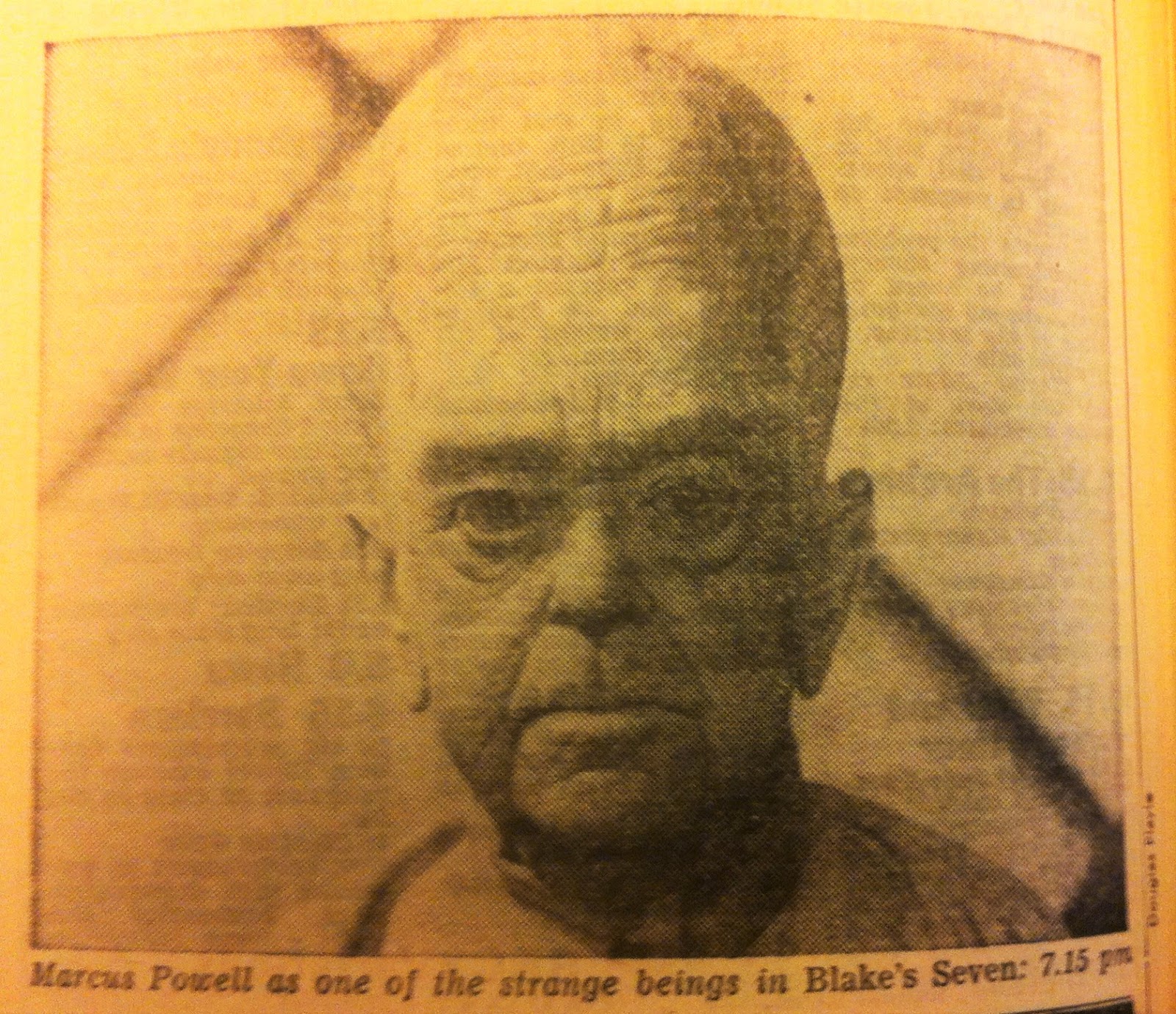
baddies, a peaceful alien race with a terrible secret, and a surprising subplot.
It’s witty, it’s nicely shot, the effects aren’t entirely disproportionate to
the budget but (when we see Vilaworld) they do just go slightly beyond what
they can afford, which is how I like it. Also, the Doctor Who guest stars this week outclass even Michael Gough.

I say this felt like familiar territory,
but in a significant way it didn’t. This was a story about Vila for a change. It
actually gave us a story told from his perspective, and was full of people
trying to see things his way. The result was lovely and human. I don’t want to
sound too predictable, but having a human, trickster hero did remind me of the
mothership: i.e. Doctor Who.
It was so niftily written. From Vila’s
point of view, Villains like Baban the Barbarian aren’t rivals or existential
threats or mirrors or anything like the villains in other stories: they are,
simply, stupid bullies. And Baban was great fun in that role. The city puzzle
box transmat space ship – well, it didn’t make perfect sense, but it was different:
a riddle, a battle of brain rather than brawn.
Vila really talked and acted like a clever
guy this week, talking about the architect of the riddle as if he was still
around. He didn’t just point a sonic suitcase at a lock.
And this was a story that benefits so much from
happening in this time of upheaval, Tarrant jostling for captaincy, Avon
quietly asserting his authority. I don’t know what happened with Jan Chappell’s
performance, but she was suddenly more assured and steely – and I put this down
to the more interesting group dynamic amongst the crew. Where might this lead?
It’s a credit to Boucher, and a reminder
that the show hasn’t yet exhausted all its potential, despite the last few
stinkers.
Speaking of stinkers, there was Carol:
though she did, admittedly, take a shower halfway through the adventure. Of
course, this being his story, Vila had to finally get a romantic storyline.
Maybe I’ve just had too much blue space cocktail, but I found it very touching,
even though it happened on fast forward. It would have been nice for Carol to
stay as tough and smelly as she was when they first met, but it was also nice
that Vila got to play the matinee idol hero. Nothing approaching this is going
to happen again to Vila again.
One of my most persistent gripes with this
show is that it’s overloaded with lead characters. In this story, Chris Boucher
demonstrated how a story could emphasise one particular lead above the others –
while still giving everyone something to
do – and subtly colour the narrative a different hue to others in the series.
Since they can hardly vary the settings and locations very much, this seems to
be a skill the other writers should get the hang of quickly.
Most ridiculous of all, I actually welled
up a bit when Vila said he couldn’t come to ‘Homeworld’ because there was
nothing to steal there. I couldn’t help feeling that Chris Boucher was talking
about being a writer. Most other professions are transferable to other
situations – or perhaps people don’t feel defined by them. But could a writer
survive in a world without a past, without riddles and challenges and stuff to
do. Who would he be?
Of course, Vila is more a trickster than a
thief. So maybe there is a kind of dignity in the analogy. All I know is,
however little he might fit into other people’s stories, I’m glad that there is
someone like Vila in the world of Blake’s 7, and that now and again he scores a
victory over someone like Tarrant.